
Ryan Knox for MIA: The regional model transforms waste management from a series of partial local solutions into a modern public service
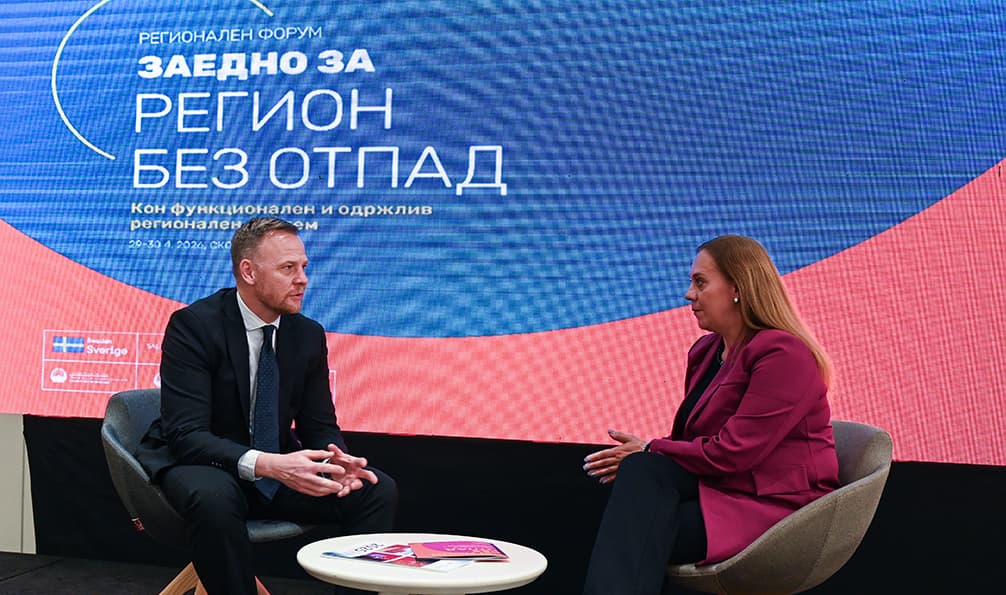
-The waste management system in North Macedonia is at a turning point. The country has adopted solid legislation aligned with EU standards, but implementation still lags behind. The system remains fragmented, with unequal service coverage, a very low recycling rate, and a reliance on landfills that do not meet prescribed standards," says Ryan Knox, Executive Director of SALAR International, in an interview with MIA. SALAR International is a part of the Swedish Association of Local Authorities and Regions, which is a counterpart to ZELS (Association of the Units of Local Self-Government). He adds that, nevertheless, more and more municipalities are starting to view waste management not just as an expense, but as an opportunity linked to public health, environmental protection, and, very importantly, EU accession.
Knox participated this week in the Regional Waste Management Forum titled "Together for a Waste-Free Region: Toward a Functional and Sustainable Regional System," held in Skopje. The forum was organized by the project "Sustainable Waste Management at the Local Level," funded by Sweden and implemented by SALAR International in cooperation with the Ministry of Environment and Physical Planning, the Ministry of Local Self-Government, and ZELS.
-Our recent study on the impact of EU accession on local governments clearly shows that this sector is a critical entry point for reform where progress can accelerate alignment with EU standards and deliver visible improvements for citizens, says Knox.
This year, citizens in all 18 municipalities of the Pelagonia and Southwest regions will receive bins for waste disposal and separation, while public utility companies will receive trucks of various sizes for efficient waste collection. These investments precede the realization of the Regional Waste Management Center, which will be built in the municipality of Novaci to serve the 350,000 residents of both regions. In addition to a central landfill, the center will feature four transfer stations and multiple collection centers. The regional center is expected to close 16 landfills currently operating without any standards.
Funding for the project has already been secured through an EBRD loan, as well as grants from Sweden and Switzerland. A Inter-Municipal Waste Management Board has been established, comprising all 18 municipalities from both regions, and a regional public utility company is expected to be formed in the coming period.
In his interview with MIA, Knox speaks specifically about this process, the benefits of the regional waste management system, the support SALAR International provides to Macedonian authorities, Swedish practices, and what can be applied from them on Macedonian soil.
Knox emphasizes that the greatest benefit is that the regional model transforms waste management from a series of partial local solutions into a modern public service.
-Today, many municipalities operate independently, often without the scale or resources to manage waste effectively. The Regional Waste Management System (RWMS) changes that by promoting inter-municipal cooperation allowing municipalities to share infrastructure, expertise, and costs, he says.
The full interview with the Executive Director of SALAR International, Ryan Knox, follows below:

. You recently spoke at the regional waste management forum in Skopje. How would you assess the current situation in North Macedonia? What are the main challenges municipalities face?
-North Macedonia’s waste management system is at a turning point. The country has adopted solid legislation aligned with EU standards, but implementation still lags behind. The system remains fragmented, with uneven service coverage, very low recycling rates, and continued reliance on non-compliant landfills. Country’s decentralization process has been institutional rather than functional. As a result, municipalities carry much responsibility, but often without the necessary resources. Limited technical capacity, weak fee collection systems, and low tariffs create a cycle where services cannot improve because they are underfunded, and citizens, in turn, are reluctant to pay for services they perceive as inadequate. There is also a political dimension. Waste infrastructure projects, such as landfills or transfer stations, can be sensitive, especially during election periods. This can delay decision-making and slow reforms. At the same time, we are seeing a gradual shift. More municipalities are beginning to see waste management not just as a cost, but as an opportunity linked to public health, environmental protection, and importantly, EU accession. Our recent study on the impact of EU accession on local governments clearly shows that this sector is a critical entry point for reform where progress can accelerate alignment with EU standards and deliver visible improvements for citizens.
The Regional Waste Management System is being introduced as a key reform. What makes it better than the current model?
-The biggest difference is that the regional model replaces fragmentation with cooperation. Today, many municipalities operate independently, often without the scale or resources to manage waste effectively. The Regional Waste Management System (RWMS) changes that by promoting inter-municipal cooperation allowing municipalities to share infrastructure, expertise, and costs. This makes it possible to build modern facilities, improve efficiency, and meet EU environmental standards. It also introduces clearer governance structures, such as regional boards and, soon enough, regional utility companies, which strengthen accountability. For citizens, the benefits are very tangible: more reliable services, cleaner environments, and better opportunities for recycling. Key infrastructure like regional landfills, transfer stations and waste collection centres coupled with introduction of waste selection and gradual closing of illegal dumpsites ensures cleaner and safer environment. In essence, it transforms waste management into a modern public service rather than a patchwork of local solutions.
SALAR International has been working closely with Macedonian partners. What have been the key results so far?
-The project has focused on building the foundations for long-term change. One major achievement is the development, adoption and successful delivery of Local Action Plans across 15 partner municipalities. These plans translate national strategies and the Regional Waste Management Plan (RWMP) into concrete, operational local actions and have been developed through inclusive processes involving municipal staff, utility companies, and citizens. Capacity building has also been central. Through training, mentoring, and study visits, (particularly to Sweden and Serbia) where SALAR International supports similar initiatives, mayors and technical staff from both, municipalities and public utility companies, have gained practical knowledge and, just as importantly, a new perspective on what is possible. In addition, with the support of Swedish and Macedonian experts, a range of tools and methodologies have been created supporting municipalities in planning, implementation, and decision-making (hyperlink to the website). We have also supported real progress in inter-municipal cooperation. The establishment of the Inter-Municipal Waste Management Boardfor Pelagonia and South-west regions, is especially significant, as it signals growing ownership among municipalities. One of its first decisions was to initiate the development of a new regional plan, a process that is already starting today after the Forum. Finally, citizen engagement has started to improve. Through awareness campaigns, school programmes, and pilot initiatives in waste selection, municipalities are increasingly opening up to dialogue with citizens and civil society organizations, supported by a methodology introduced by SALAR International. While small, these are important steps toward changing behaviour, building trust, and ensuring the long-term sustainability of the system.
Sweden is often described as having one of the world’s most advanced waste management systems. What makes the Swedish model successful, and why is it of interest for other countries?
-Sweden’s waste management system is often admired internationally, but we should be humble about this. It has been built over decades and is still evolving, particularly when it comes to prevention, reuse and recycling. That said, the results are clear: landfill has been reduced to minimal levels, waste is treated as a resource, and municipalities deliver reliable, citizen-focused services. What makes the system work is not just technology. It’s the combination of long-term policy, clear responsibilities, inter-municipal cooperation, and strong public trust. Municipalities often collaborate through joint waste companies, which allows them to operate efficiently and at scale. Sweden has also been proactive in responding to EU environmental legislation, treating it as a driver for innovation rather than just compliance. This is a key lesson for countries like North Macedonia, where EU accession can accelerate reforms if matched with local capacity and accountability. There is strong international interest in Swedish solutions. Through our partnerships and work with Team Sweden Smart Cities, we see that countries are not only looking for technical solutions—they want to understand how municipalities organise themselves, engage citizens, and make systems work in practice. Ultimately, the lesson is simple: sustainable waste management depends on ownership, cooperation and trust.
How transferable is the Swedish experience to North Macedonia?
-Sweden offers a strong reference point, but it’s not a copy-paste model. What is transferable are the principles: cooperation between municipalities, clear governance structures, financial sustainability, and strong citizen engagement. Sweden shows how a system can work when these elements are in place. Through the project, these lessons are being adapted to the Macedonian context. Study visits and peer exchanges, including engagement with practitioners from Swedish municipalities and public utilities working alongside our partner municipalities in North Macedonia, have been particularly effective in showing local leaders what a functioning system looks like in practice. inBut success ultimately depends on local ownership. Solutions must fit the political, financial, and social realities on the ground.
Are local governments and utility companies ready to implement and maintain the new system?
-There is progress, but also a clear need for continued support. Capacities vary significantly between municipalities. Some are moving forward quickly, while others still face serious constraints in staffing, financing, and technical expertise. That said, awareness and engagement have increased noticeably. Waste management is becoming a higher priority for many local leaders, and public utility companies are beginning to modernise their operations. The real challenge now is sustainability,ensuring that these improvements are institutionalised. This includes strengthening financial systems by introducing a functioning tariff mechanism, improving data collection, and establishing the Regional Utility Company, which will be critical for operating the new infrastructure.
What are the next crucial steps to achieve a fully functional and EU-compliant system?
-Several priorities stand out. First, inter-municipal cooperation must move from planning to full implementation. Regional structures need to become operational and effective. Second, citizen engagement has to be scaled up. Waste management systems only work if people participate, by separating waste, paying for services, and supporting reforms. Third, financial sustainability must be addressed. Without realistic tariffs and better collection systems, the system cannot function in the long term. Fourth, EU accession should be used more strategically. The requirements of the EU acquis provide both a roadmap and a strong incentive for reform. Finally, governance and accountability are key. A sustainable system depends on clear roles, strong ownership, and effective checks and balances between institutions. What is equally important at this stage is to maintain momentum. With key foundations already in place, continued use of the experience and practical tools developed through the SALAR International project can help accelerate implementation and avoid delays. If these elements come together, North Macedonia has a real opportunity to build a modern waste management system, one that is not only compliant with EU standards, but also delivers tangible benefits to its citizens.