
Panel discussion in Resen: Sustainable waste management requires a systemic approach, coordination, and cooperation
The Prespa region is entering a new phase of improving its waste management system.
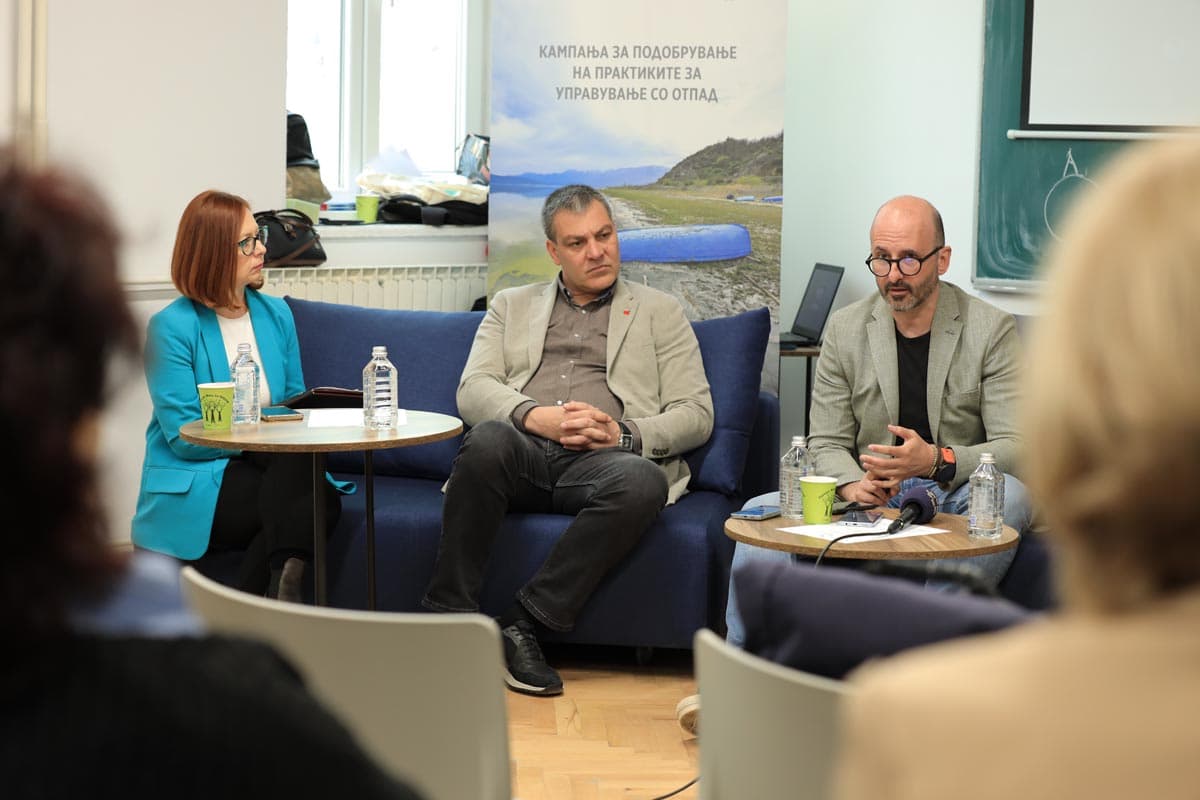
At the panel discussion "For a Cleaner Prespa: Joint Steps for Better Waste Management," held in Resen on April 23, it was emphasized that waste management is a process that requires a systemic approach, institutional coordination, and the active involvement of all stakeholders. The participating panelists agreed that for Prespa to achieve sustainable waste management, parallel action is required both at the policy level and on the ground.
During the panel discussion, emphasis was placed on the fact that while the foundations have already been laid, the next phase demands more clearly defined activities, better coordination, and continuous investment in both infrastructure and capacities. Waste management is a process that directly impacts the quality of life, the protection of natural resources and biodiversity, and the development of the region—especially considering that Prespa is an ecologically significant area for the country and the region.
Meanwhile, concrete results have already been achieved at the local level. The Municipality of Resen is implementing activities to clean up illegal dumpsites, with six out of nine identified locations already cleared. The plan is to completely rid the region of illegal dumpsites by the end of the year—a step that will significantly contribute to improving the environment and public health. Additionally, new waste collection vehicles have been procured, several initiatives for separating plastic, textiles, and glass are underway, work is being done on a composting facility for organic waste, and educational campaigns are being conducted in schools and kindergartens, demonstrating that change in Prespa is truly possible.
While these activities may seem like isolated interventions, they are actually part of a broader process of establishing a sustainable Regional Waste Management System (RWMS), as discussed by Emil Angelov from SALAR International. The RWMS is crucial for sustainable waste management and involves multiple parallel activities, such as closing illegal dumpsites, constructing collection centers and transfer stations, and, of course, building the new modern landfill near Novaci. The project "Sustainable Waste Management at the Local Level," implemented by SALAR International in partnership with the Ministry of Environment and Physical Planning, the Ministry of Local Self-Government, and ZELS, cooperates closely with both national institutions and the 18 municipalities in the Pelagonia and South-west regions to implement the RWMS. The results are already visible, and the reform process is in a new phase, where the focus is shifting from planning to concrete implementation, with clear activities, investments, and institutional changes.
The panel discussion was organized within the framework of the campaign "Prespa? Wake Up for a Clean Environment," which is implemented by the Institute for Communication Studies in cooperation with Eco Guerrilla Prespa and the Macedonian Ecological Society, with support from the European Union through the "EU for Prespa" program.