
Waste as a serious challenge: regional centers as the solution
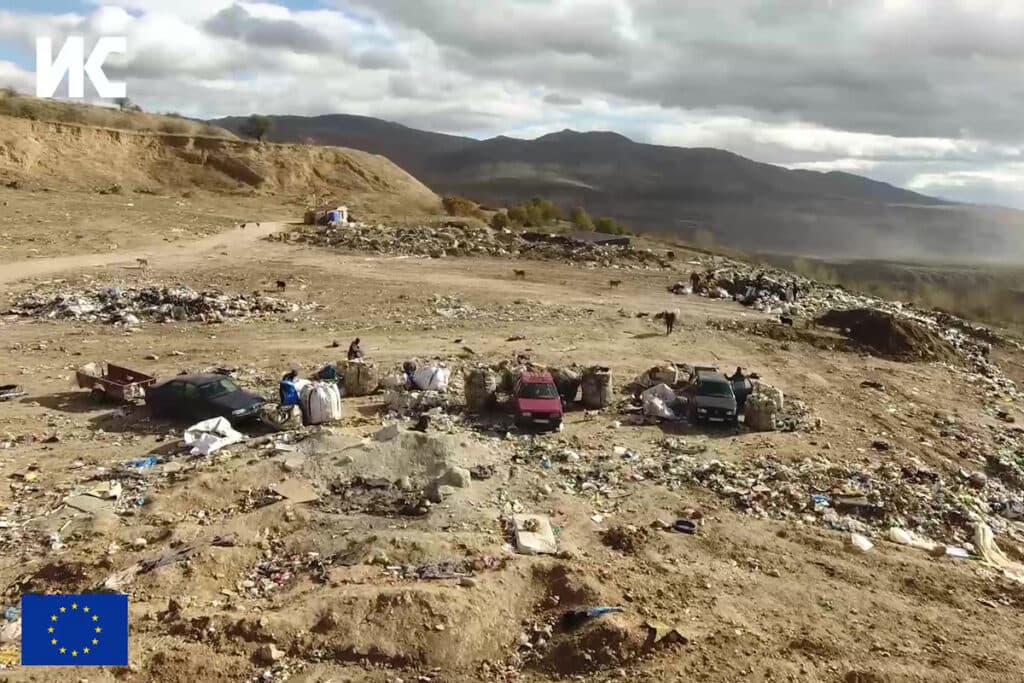
Waste management is becoming an increasingly larger and more serious problem for municipalities in Macedonia. Unfortunately, not a single landfill in our country, except in certain places like Drisla in Skopje and the landfill in Gevgelija, meets any required standards. Pollution, unpleasant odors, and constantly burning landfills—this is the picture in many places across Macedonia.
In the past, eight such regional centers were planned across the country, meaning one in each planning region. However, today, due to insufficient waste quantities and economic viability, that number has been reduced to five: Novaci for the Pelagonia and South-west regions, Rusino for the Polog region, Drisla for the Skopje region, Dobreshinci for the South-east and Vardar regions, and Sveti Nikole for the East and North-east regions.
Regional centers were precisely one of the topics at the panel discussion "For a Cleaner Prespa: Joint Steps for Better Waste Management" in Resen. The event was organized by the Institute for Communication Studies in cooperation with Eco Guerrilla Prespa and the Macedonian Ecological Society, as part of the campaign "Prespa? Wake Up for a Clean Environment," supported by the European Union through the "EU for Prespa" program.
"The idea is to reduce costs. Even if certain distances seem large to us, there are many other factors that influence exactly where the transfer stations will be placed. Certain municipalities will be able to take their waste directly to the landfill in Novaci, while others will take it to a transfer station. A regional public utility company will operate the center in Novaci and the transfer stations, and it will also handle the transport and manage the landfill itself. The municipalities and their utility companies will continue to manage waste at the local level, collecting it and taking it to the transfer station instead of a landfill," said Emil Angelov from SALAR International.
The regional center in Novaci will cover 18 municipalities, starting from Centar Zhupa all the way to Struga, Ohrid, Kichevo, and all those municipalities gravitating toward the Pelagonia planning region.
"For the landfill, the tender for the contractor is planned to be published by the end of the year, and it should be built and operational in about two years. What remains a serious problem moving forward is the closure of existing municipal landfills. We are talking about 16 landfills in these two regions, and according to the assessment we conducted three years ago, closing them would require around 30 million euros. That is too large a sum for any single municipality to provide on its own, so the state will likely have to intervene again through a project," Angelov added.
To solve the waste problem, Resen has already started with a certain degree of separation for glass, textiles, and electronic waste, and by September of this year, 2,000 yellow bins for household paper and plastic separation should be distributed. By 2028, Resen should also receive a composting facility and a crusher for recycling construction debris, which, alongside Prilep, should position it as one of the two cities leading this process in Macedonia.
"We inherited nine inhabited areas where waste was not being collected. In 2023 and 2024, we reduced that number from nine to six, and in 2025, upon receiving two waste collection vehicles through the 'EU for Prespa' program, we reduced it by another three. In 2026, our goal is to cover all inhabited areas, regardless of the number of residents, so that waste is collected even from places where the least amount of garbage is generated, keeping in mind that we previously did not operate in those areas," noted Marchel Rusu, Director of PUC Proleter Resen.
"I will address a few challenges, one of which is strengthening cross-sectoral cooperation. We truly need it, because local self-government, without cooperation at all levels, horizontally and vertically, cannot fully implement this concept on its own. Expert and financial support are also essential for implementing the legislation in this field," emphasized Ayman Al Malla, Head of the Environment Department at the Municipality of Resen.
As part of environmental protection, five sewerage systems with small wastewater treatment plants are currently being built in Prespa—in Pretor, Stenje, Dolno Dupeni, Krani, and Brajchino—and they should be completed by September this year.
"Prespa Lake and the entire fragile biodiversity around it will experience the most direct benefit. Additionally, about 1,500 people who will connect to the sewerage system that treats wastewater will benefit directly because, in the end, whether through a river, directly or indirectly, all of it gravitates toward Prespa Lake," says Zoran Trajchevski from the United Nations Development Programme (UNDP).
However, alongside infrastructure solutions, raising citizen awareness about waste separation is crucial.
"I hope that public awareness will rise to a higher level because this is something we must do for ourselves. Now that we are already a well-known and respectable region, it is a pity to destroy it ourselves when it is nestled between two national parks, a beautiful lake, a fresh air resort, and the like," noted Jovan Tozievski, Mayor of Resen.
Otherwise, unfortunately, 99% of waste in Macedonia still ends up unseparated in landfills, and an additional 20 to 30% is dumped in various garbage heaps, meaning illegal dumpsites that can be found at every turn.
The story was produced by the Communication Studies (ICS) in cooperation with Info Kompas as part of the waste management campaign in the Prespa region „"Prespa? Wake Up for a Clean Environment,"“, which is supported by the European Union through the "EU for Prespa" program. The content is the sole responsibility of ICS and does not necessarily reflect the views of the European Union.